
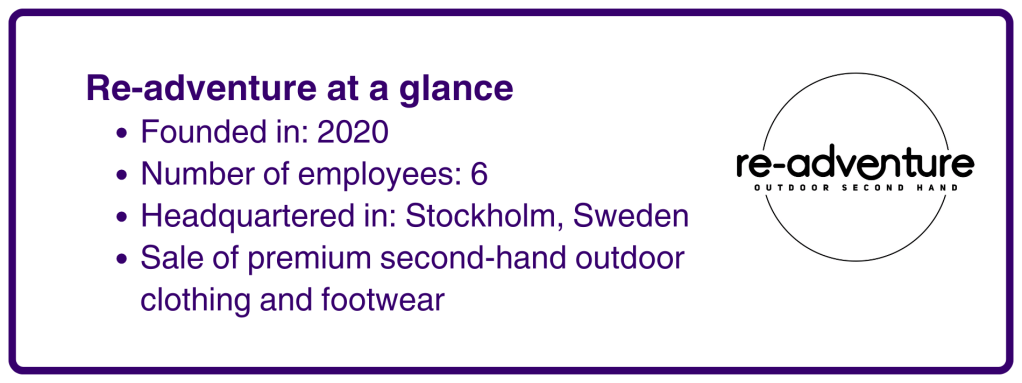
Recommerce Review: Hello, Kicki! Thank you for taking the time. Your co-founder Jenny Kask and you are both seasoned professionals in the fashion industry – how did you come to start Re-adventure?
Kicki Olivensjö: That’s true, Jenny and I have both been in the fashion industry for quite some time. I worked as a purchasing manager at H&M, and Jenny had similar roles at other fashion companies. She also worked with Houdini, a Swedish outerwear brand that’s really known for their environmental focus. After leaving our former jobs we both found ourselves with a bit of free time and the wish to start a new project. We met up for dinner one night and realized we both had similar ambitions and wanted to do something more meaningful. So that’s when the idea for Re-adventure was born.
RR: What other businesses did you look to for inspiration when developing the idea?
Kicki: Houdini was a big influence, as they’ve always been ahead in terms of sustainability. Jenny helped set up their first second-hand store in Stockholm, which they ended up closing after one year, integrating the concept into their usual retail spaces. But the approach stuck with Jenny and she had the idea of exploring this business model independently. Another key inspiration was Arkivet, a second-hand store chain focused on high fashion and a selection of mass-market brands. What stood out about them was how they curated everything so that it felt like walking into a regular fashion store, not just your typical second-hand shop. We wanted to bring that same feeling into the outdoor clothing space.
RR: What was it about the combination of second-hand and outdoor clothing that made you both feel like this was something promising to work on?
Kicki: For us, it was really about combining purpose with quality. Outdoor clothing is built to last, and it just felt wrong to see high-quality gear go to waste after barely being used. These are garments designed to withstand tough conditions, so giving them a second life made sense from both a practical and environmental perspective. It was a great opportunity for us to do something that aligned with our values, where we could contribute to reducing waste while still offering people great products.
“Outdoor clothing is built to last, and it felt wrong to see high-quality gear go to waste after barely being used. These are garments designed to withstand tough conditions, so giving them a second life made sense from both a practical and environmental perspective.”
RR: What challenges did you face in setting up your initial operations?
Kicki: The first big hurdle was finding the right location. Rent in central Stockholm is high, so getting the right deal was crucial, especially in the beginning. After asking around a little, one of the biggest property owners in Sweden, AMF Fastigheter, got to know that we were looking for a store. They are also frontrunners when it comes to different business models and sustainability. They offered us a retail space in Västermalmsgallerian, one of the nicest malls on Kungsholmen, the central western island of Stockholm. And we negotiated a deal with them and started a pop-up store.
RR: Sounds like a very hands-on setup! How did you manage to get your initial supplies?
Kicki: In the beginning, we relied heavily on our personal networks. We reached out to friends, family, and colleagues in the industry and asked them to clear out their closets. We collected about 250 garments just by driving around and picking up boxes and bags of clothes. It was a very grassroots operation at first—just Jenny and me preparing everything from our homes. It wasn’t ideal, but it worked to get us started. Over time, word spread, and more people started to bring in their items, which helped us build up our stock.
RR: As you opened the pop-up back in November 2020, you must have been hit quite hard by the second wave of COVID lockdowns. How did you experience that time?
Kicki: Yes, it was definitely a tough time. We opened the store just a few days before the restrictions tightened due to the second wave. It limited the number of people we could have in the store and affected our opening hours. Despite this, we noticed that the outdoor market grew during the pandemic because people were spending more time outside. So it actually helped us in a way—customers were looking for quality outdoor clothing, and we had it. For traditional fashion stores on the other hand, it was a more difficult time, because all of a sudden people didn’t need another fashion top to go out or whatever. But in our case, even with the restrictions, we saw steady interest and were able to keep things going.
RR: Now, after the initial phase you are still in the same store, right? How did this develop over time and did you build up your online presence right from the start as well?
Kicki: Yes, we’re still in the same store in Västermalmsgallerian. Through some word-of-mouth and classic marketing via Google, Facebook and Instagram the foot traffic has increased a lot, and we’ve developed a loyal customer base, which has been fantastic. For some time, we also operated a second store in Sundsvall, about 4 hours north of Stockholm, but we closed that down again.
As for our online presence, it’s been a slower build. We launched our website alongside the store and we’re running it on Shopify, but we’re also on platforms like Swedish online marketplace Tradera. It’s definitely an area we’re working on expanding, but managing a second-hand business online is tricky. Each item is unique, so it’s a lot of work to photograph and list everything.
RR: What does your sourcing look like today?
Kicki: Over time, we were able to build more and more of a community that today contributes 95% of our supply. Those are people that take part in our consignment model, which is the core of our business. Essentially, they bring their outdoor clothing to us, we sell it on their behalf, and they earn a percentage of the sale price. We handle the rest, such as pricing the items and displaying them in the store.
We’ve also expanded a bit into other sources. About 5% of our inventory comes from stock lots, sales samples, and items from agencies. This includes things like gloves, hats, or socks—smaller items that people need but don’t often consign. These are usually surplus stock or samples that can’t be sold in traditional retail. While we’re careful not to turn into a stock-lot store, adding these items helps meet customer demand for essentials, especially during the colder months. The key for us is maintaining a balance—we want to stay true to our circular model while making sure we have a good mix of products that people need.
RR: You mentioned that keeping track of all the products is not easy, especially with all these segmented sources of clothing from the community, so how do you manage your inventory? What are the steps to get the pieces into the store and what do you do if they don’t sell?
Kicki: Managing inventory is definitely one of the more complex aspects of running Re-adventure, especially since each item is unique. When someone brings their clothing to the store, the first thing we do is inspect it for quality. We make sure the garments are clean and in good condition—anything with damages or heavy wear is rejected.
Then we take pictures and add those together with all kinds of information on the garment into our warehouse management system. After that, we price the items based on their condition, brand, and how much similar items are going for in the market. Considering all this, we look at the initial retail price and price the product for us at around 50% of that. In the end, we also list it in our online shop and on Tradera. This whole process is done by our in-store team, so everyone who works at the store is involved in these tasks.
Once an item is accepted, it’s displayed in the store for about 60 days. After that period, the responsibility shifts back to the person who consigned the item. We try to make the process easy for them, but it’s on them to contact us after those 60 days to decide what happens next. If they don’t want the item back, we offer to donate it to charity on their behalf, often to organizations like Stadsmissionen or Myrorna, that run charity shops in Sweden. This happens mainly with lower-priced items like workout gear or accessories.
For more expensive pieces—say a jacket worth several hundred Euros—we make an effort to reach out to the consignor ourselves to see if they want to pick it up or if they’d like to try selling it through another channel. Some of these items may also sit longer than 60 days with us, especially if we believe they’ll sell when the right customer comes along.
RR: You mentioned how you are determining the sales price of a product, but what portion of the price remains with Re-adventure?
Kicki: Of course we must find a balance between staying competitive and also ensuring we cover our costs, while the consignor must be happy in the end as well. So for the split, after VAT, we typically take 48% of the sale price, and the consignor gets 40%. It’s a fair system that works for both sides.
RR: So, on a per-product basis, a nice margin! How do you perform overall in regards to revenue and profitability?
Kicki: We’ve been steadily growing year by year. Last year, we increased our revenue by 35%, and this year we’re seeing similar growth. While Jenny and I are not earning salaries yet, the business is profitable. The store itself brings in about 80% of our revenue, with the website contributing the remaining 20%. We’d like to reverse that ratio eventually, but for now, the physical store is the backbone of our business.
RR: You mentioned earlier that there used to be a second store in Sundsvall. Let’s talk about that. Why didn’t this work, and do you think you are going to grow through additional stores in the future? What other avenues of growth do you see for Re-adventure?
Kicki: Sundsvall was a learning experience for us. The idea was promising: INGKA, the company behind IKEA, reached out to us about their “Circuit” concept, which was part of a new sustainable retail model they were piloting. They offered us a space in a mall in Sundsvall, which is a hub for the northern part of Sweden. We were really excited about it because we thought it would be a great fit, especially since outdoor gear is popular in that region. But unfortunately, it didn’t work out as we had hoped.
The main issue was supply. Unlike in Stockholm, where we have an established community bringing in clothing, in Sundsvall we had no local network. People weren’t bringing in their garments as much as we expected, so we ended up having to send goods from Stockholm, which created extra costs for transport. We didn’t have the infrastructure to handle stock in different locations and weren’t able to list the Sundsvall inventory online, which added to the challenges. Also, as part of the bigger concept of Circuit, there was no dedicated service staff for our products and it did not make sense for us financially to hire someone for that, so customers did not receive the kind of support we are offering in Stockholm.
Looking forward, we’re still interested in expanding, but we’re focusing on Stockholm for now. We think there’s room for at least two more stores within the city. Anyway, it has to be the right fit, we need to make sure the location is sustainable for us in terms of both supply and customer demand.
Beyond new stores, we’re also looking at growing our online presence. We have sold to international markets before, for example to customers in Japan and Germany, and we see potential in that for sure. But for that, we’ll need to increase our marketing presence and invest more money into that while also developing our marketing skill set as well. If we are able to do that, I think there’s huge untapped potential for our business.
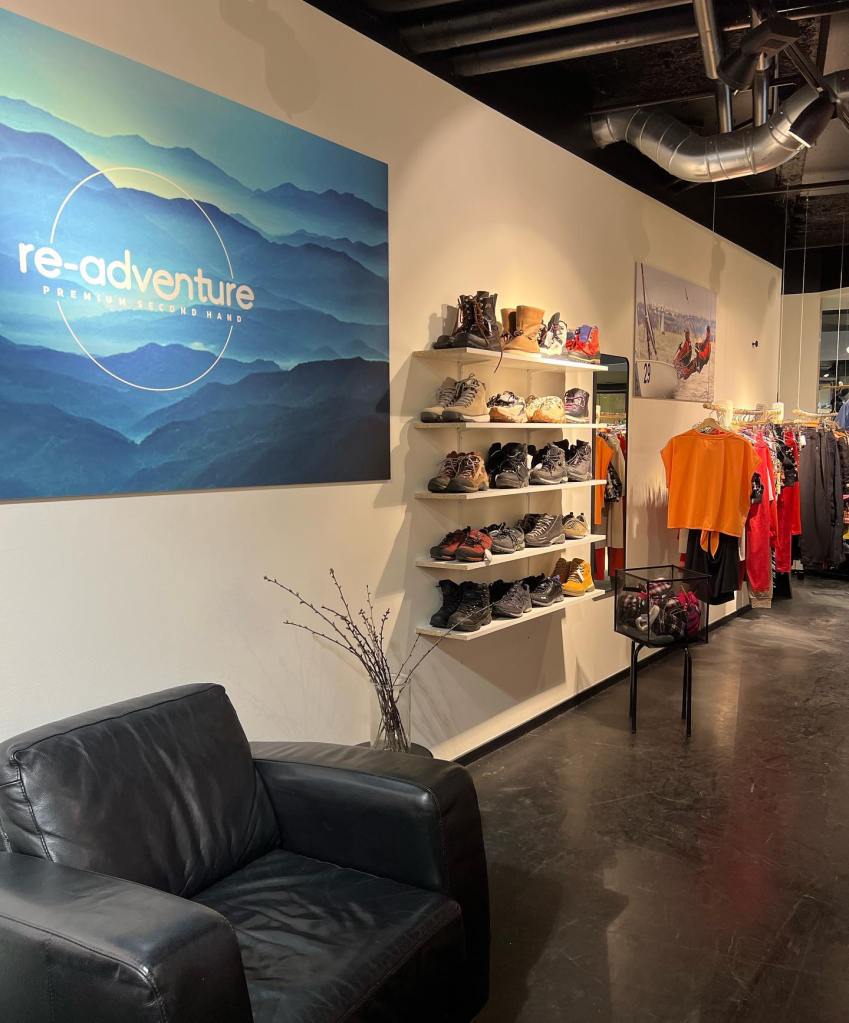
The inside of Re-adventure’s store at the Västermalmsgallerian in Stockholm.
(Photo source: Re-adventure)
RR: With that in mind, how scalable are your processes of inventory management and supply through the community?
Kicki: We’ve looked into options for outsourcing parts of the inventory management, like photographing and cataloging items, but it’s quite expensive. For our business model, especially with lower-priced goods, this just doesn’t make sense right now. So, we’ve kept the process in-house, and our team still manages everything manually. However, if future stores perform well enough, it could become feasible to add staff that focuses on this responsibility.
That said, we’ve found that in cities like Stockholm, especially when the stores are easily accessible, it’s much easier to rely on the community to keep our supply steady. Our customers are engaged and willing to bring in their clothing, so we don’t have to worry as much about sourcing. Also, timing is key. For example, if we’re planning to open a location in September, we’ll start reaching out to our community in July, asking them to bring in their items. This has proven to be a very reliable way to ensure we have enough stock when we open. Also, our current store is actually too well supplied and we could redistribute some of that inventory to a new store.
RR: Interesting! What else do you need to be fit for growth in the midterm? Are you looking for partners or investors?
Kicki: Right now, we’re considering two potential ways of getting some additional funding. One option is to bring in a third shareholder who could complement the skills that Jenny and I already have. Both of us are very much product- and sales-driven, but we recognize that we lack some expertise in areas like IT, scaling operations, or strategic marketing. Ideally, we’d find someone who has those specific skills and who could also invest in the business. This would help us manage the growing complexity of running Re-adventure as we expand into more stores or increase our online presence.
The second option is to look for external investors, such as business angels or venture capital firms. However, we’re cautious about going down this route because we know that taking on external funding means a higher level of reporting and additional demands from investors. We also want to ensure that any investor shares our vision and commitment to sustainability. We’ve always been hands-on and close to the business, and we don’t want to lose too much of that control as we scale.
Another area we’re exploring is partnering with larger brands that are interested in the second-hand space. We’ve already been approached by a few well-known outdoor brands about the possibility of managing their second-hand or rental programs. It’s an exciting prospect because it would allow us to expand without having to open more physical stores. Instead, we could act as a facilitator for these brands, leveraging our expertise in the circular economy. We see this as a potential win-win, as it could help us scale while staying true to our core values of sustainability and quality.
We discussed one potential partnership with the INGKA Group. They are growing their investment in the “Circuit” project that I mentioned earlier, and although the pilot project in Sundsvall didn’t work out, they had expressed interest in collaborating with us again. This could have opened doors for us to become a key player in this initiative and it would have allowed us to scale globally very quickly. But, while this was a big opportunity, it also came with significant risk for us and we didn’t feel like it would be the right moment for us to take this step.
RR: That really sounds like a major opportunity but also like one that would have changed Re-adventure fundamentally. What do you think of the established, linear outerwear brands like Houdini and Naturkompaniet that have entered the second-hand market? Are these some of the potential collaborators you have mentioned earlier or do you see them as competition?
Kicki: Of course, you could argue that a customer who goes into the store of Houdini or to Naturkompaniet (a Swedish multi-brand outdoor retailer) because of their second-hand offering, would have come to us instead if those companies didn’t offer that. So in some sense they are competitors.
But in the bigger picture, we appreciate that those companies are getting into the second-hand space as it also raises awareness about sustainability in general and circular options in particular. And it is not easy for them. Especially for brands that are new to this, it is hard to implement the processes to facilitate such models. Also, they risk confusing their staff and some customers alike, selling new and used goods in parallel. In such cases, as I mentioned, we believe it would be beneficial for these brands to work with us as their partners on this, as we have the experience with this. So this could also pose an opportunity for us.
On the other hand, many of these brands are strategically not committed to the second-hand model and see it as more of a marketing tool, still relying on the sale of new merchandise to succeed.
Other brands though, like Houdini, have it in their DNA. From them, the customers really expect it and they would lose significant brand authenticity if they would stop offering it, although I am not sure whether it is positively affecting their bottom line directly. And I do think they deliver it in a very holistic manner, also offering equipment rental and repairs.
After all, I do believe that we are in a good position to compete with all these companies, as we have the advantage of offering all kinds of brands in our store and can as such offer a wider variety than D2C brands with their own stores, like Houdini. Also, our consignors receive an actual payout for their goods, while at other brands they only receive a voucher that they need to reinvest at the store, like it is the case at Naturkompaniet. Additionally, as I have mentioned before, our community is growing into a real and loyal asset for us!
“Many brands are not strategically committed to the second-hand model and see it as more of a marketing tool, still relying on the sale of new merchandise to succeed. Other brands, though, have it in their DNA. From them, the customers really expect it and they would lose significant brand authenticity if they would stop offering it, although it may not positively affect their bottom line directly.”
RR: You seem well set up for competing. What are your objectives for the near future? What do you think, how is Re-adventure going to change in the next 3 to 5 years?
Kicki: The overall feedback we receive from our customers is that they love our concept and we are also encouraged by discussions with potential partners. So, we believe in what we do and are convinced that it could be valuable to many more customers. We want to keep growing organically, for sure through intensified marketing and new stores. Our plans for additional stores in Stockholm are well advanced, but we also feel ready for the next steps online and through one or more such partnerships with other brands. In 5 years, I think we can achieve a lot in all of these regards.
RR: I think so as well! Thank you very much, Kicki, for taking the time and all the best for Re-adventure.
Kicki: Thank you!
 Recommerce Review.
Leave a comment