
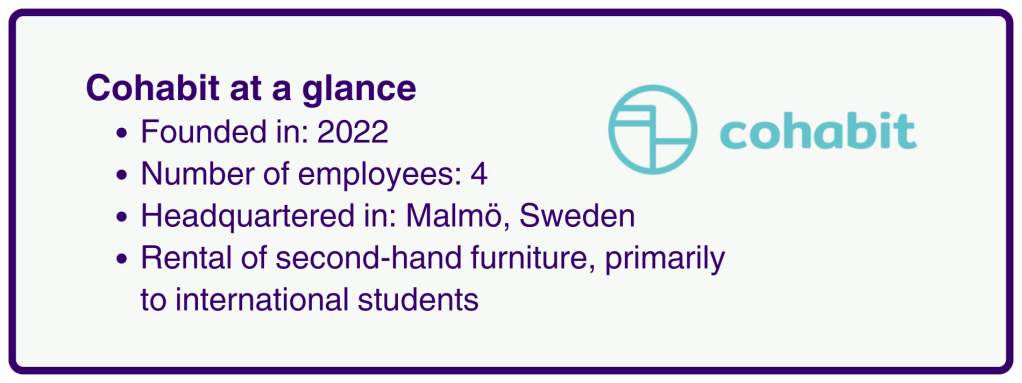
Recommerce Review: Hey, Jed! Thanks for taking the time. To jump right in, how did Cohabit come about?
Jed Manguera: Hey! Cohabit started as a school project when my co-founders Vaish, Max, and I studied the Master’s degree in leadership for sustainability at Malmö University two years ago. During the program, we had a course on social innovation and social entrepreneurship for which the final project was for us to come up with a sustainable business idea. When Vaish came to Malmö, she moved into an unfurnished student apartment, she didn’t even have a lightbulb! And while she thought in the beginning that this was a special situation she found herself in, she later got to know that it is fairly common in Sweden, and that’s what sparked our idea!
We immediately thought that providing a solution to this problem would be a good business opportunity. And based on our research during that time, we didn’t identify an existing company that was doing so. This way, the idea to offer rental furniture to students was born, providing a convenient, more affordable, and sustainable alternative for students when it comes to furnishing their apartments. Our professor also liked the idea and encouraged us to pursue it. This led to us being part of two incubator programs in Malmö and developing our minimum viable product over the summer. It was a really fast process that took us from an idea into a working prototype MVP within four months.
RR: That’s a quick start!
Jed: Well, we had to develop it quickly because we were aware that the new students were going to arrive soon! Of course, the business itself is quite seasonal, a lot of our customers arrive usually during the start of every semester. In Sweden, that’s usually around August, September or around December and January. So, right after we graduated our program, we had three, four months before the new students would arrive, which meant we really had to work fast to make it happen.

The founders of Cohabit, from left to right: Jed, Vaish, Max and their fourth co-founder Chandru who joined later on. (Photo source: Cohabit)
RR: How did you end up identifying this circular approach as a solution?
Jed: We realized that if this is a problem that international students experience in the thousands every single semester all throughout Sweden, then it also ties into a bigger environmental problem, which is furniture waste. Every single time a student moves in, new furniture would have to be brought in, and then every time a student goes out, furniture is also thrown out. And so far, the most convenient way of furnishing an apartment is just to buy it brand new. So usually students just opt for buying it from Ikea. Although there are second-hand options, and although there are people who are more environmentally conscious who would like to shop second-hand, still quite a large number of students would end up purchasing new furniture. So this is a cycle that’s been going on for many years, and we just thought that we could come up with a solution to help minimize that environmental issue.
RR: Sounds like a perfect use case for a circular model with great impact! In the beginning, what would you say were the main obstacles you encountered? Reaching potential customers, finding the furniture, or rather administrative issues?
Jed: We didn’t have to worry about whether there would be customers, since the demand was clear from the beginning – every year, new students would arrive, creating a consistent cycle of potential customers. However, in the beginning it was a challenge to reach these customers. Through connections we had to our university, we fortunately had the chance to promote Cohabit through an email sent directly to all new students, which was an important first step in our communication.
But our biggest challenge was securing a reliable supply of pre-owned furniture. We found that in Sweden, especially during the summer, many people give away items for free on platforms like Facebook groups. We spent a lot of time driving around the region, collecting these items, and we were surprised by the amount of free furniture available.
However, dealing with pre-owned items brought its own challenges. The quality of the furniture varied, and cleanliness was a top priority for the students. We had to ensure that all items were in good condition and thoroughly cleaned before delivering them. In the beginning we took all the pieces of furniture we could get our hands on, but we quickly realized that repairing faulty items was just too time consuming and we also didn’t have the necessary skills in our team at that point. So we became more strict when selecting the items and focused on cleaning them and fixing small superficial damages.
RR: You mentioned your approach of acquiring customers, using administrative communication channels for students and specifically targeting international students. Are you limiting your business model to that segment? Or are there plans to also cater to other groups of customers?
Jed: Well, we believe our service fits students, and especially international students, just perfectly. For one, these students usually only stay in Malmö or the respective city they are studying in for a short period of time. Also, they usually do not have a car to transport furniture – doesn’t matter if it’s from Ikea or a furniture second-hand store – to their student home. Our model solves both these issues, so that renting from us is the more economic and the most convenient choice. If students stay longer, buying the furniture eventually does become the cheaper choice. But we are convinced that these added services like the delivery and the pick-up after the rental also play a big role for the students, so we believe it to be an attractive option even if it may not make as much sense financially for the students to go with our furniture.
That being said, of course this could also be interesting for other customers, for example expats, and we have a few customers that are not students. But in most cases, such customers have a higher income, so it is easier to outright purchase their furniture and if they would be willing to rent, they would have other expectations of the furniture as they are also able to pay a higher price. So the potential market is smaller and you would first need to extend the range of furniture for such customers, and that is why it does not make sense for us right now to actively target other customer segments.
RR: In that sense, your customer base is rather defined by their special circumstances and respective demands, than by their attitude to consumption, right? So, who would you see as your main competitors? Are there startups that offer a similar service to Cohabit?
Jed: I would say the wish to act sustainably is for most of our customers part of their decision for our service, but yes, it mainly lies in the nature of their situation.
Of course, other outlets of relatively cheap furniture like Ikea, so linear consumption, but also furniture second-hand stores are our main competitors. Also, the private secondary market like groups on Facebook are alternatives for our customers. But those also come with the same downsides for students: higher up-front investment for the furniture, the need to transport the items and also the need to dispose of them in some way once you are moving out again.
For other companies that have a similar business model to ours, there is one in Stockholm called Furnlease. They have been in business for several years now, quite successfully as far as I know, offering basically the same service as we do, but targeted to a more premium segment, so rather the expats than the students. This is of course also due to the higher number of such international professionals in a city like Stockholm. But we have no such competitors that are targeting our market of students or specifically the region of Malmö and Lund.
“The lack of standardization in your inventory automatically means it is harder to standardize your processes.”
RR: Coming back to the other issue you have mentioned, which is sourcing the furniture. With your current model of sourcing, do you think the uniqueness of every single piece of furniture can become a threat to the scalability of your model?
Jed: Yes, this is definitely a challenge for us and that, I believe, generally arises when working with second-hand supplies. The lack of standardization in your inventory automatically means it is harder to standardize your processes. Tracking the whereabouts, maintaining the quality across hundreds of different items that are not standardized, have different manufacturers, and so on, is quite a challenge we are still trying to deal with.
But in the same regard, that’s also something that we are transparent with when it comes to our customers. We tell them that, yes, this is second-hand furniture, or we call it “pre-loved furniture”. And of course, some items have a scratch here, a chip there, but we always ensure that it is functional. Even more, for some students, the uniqueness of the furniture is in a way a value in itself, compared to having the same Ikea bed that every other student has. So it can also be beneficial.
RR: Based on your current model with “pre-loved” furniture, do you have an idea of how many times you have to rent out a piece of furniture until it is profitable for Cohabit?
Jed: Right now, we have only gone through two full rental cycles. So for us it’s so far hard to determine the lifecycle of our second-hand furniture. The challenge now is that if we get a bed, we don’t know if it’s going to be good for one customer only or maybe it’s going to be sturdy enough for maybe five or seven customers. For us to get that accurate information, we would have to go through a couple more cycles and then assess what the types of furniture are that last longer. Additionally to that, the unfortunate thing about today’s furniture industry, especially when it comes to fast furniture, is that the products are usually not as durable as with older furniture.
RR: Okay, understandable that these are complicated estimates. When it comes to generating revenue, how do you go about pricing? And which role do deposits play?
Jed: Obviously, students as our main customer segment are very price sensitive. So we try to calculate our prices in a way that if you would rent the furniture for twelve months it would not be much more expensive than buying the furniture yourself. This way, considering the added services such as delivery and pick-up, our offer is always attractive for the core customer.
And while we do take deposits, usually one month’s rent, our process of assessing the damages and calculating charges to the deposit is not fully developed and needs readjustments over time. But of course we try not to rely on deposit charges to make a customer profitable for us.
RR: Fair enough. With these issues actively being solved and more and more students being aware of your service, have you reached profitability yet or when do you think you are going to do so?
Jed: Based on our projections we have a specific number of customers set out that we have to hit for us to become profitable. We’re still working towards that number right now and as you say there are some issues to solve, as we also do not want to compromise the happiness of our customers just to reach that goal as quickly as possible. So we’re working towards that number, and if all goes well, we will hopefully reach it by next year.
“It’s difficult enough to sustain a business, and it’s especially difficult if we’re talking about a sustainable business.”
RR: That’s a nice outlook! More generally on the issue of profitability, do you sometimes feel like being a sustainable company while also trying to make money off of it is seen as a conflict by some customers and the general public?
Jed: My opinion on this is that you have to be clear as to what type of organization you’re building. Because if you say that you want to create a social project, a non-profit organization that aims to solve societal, environmental issues, then it’s normal to have profit as the least of your priorities. But if you want to position yourself as a business, I feel that even if you are a sustainable business, the profit part should always be considered to be very important. Because realistically, it’s difficult enough to sustain a business, and it’s especially difficult if we’re talking about a sustainable business. You also have to sustain the business financially! And you are lucky if you’re able to get grants and funding here and there. But the reality is, you have to find a way to generate revenue to sustain the business in the long run.
RR: So the clear goal is to become profitable, but you are not yet at that point. How are you financing the company in the meantime?
Jed: Right now we are trying to bootstrap the business as much as possible, funding our operational cost through the revenue we are generating with present customers. Additionally, we have received some grants like the Leapfrogs Scholarship and support by the Vinnova fund for innovative impact start-ups, that has helped us setting up the business and investing in some strategic topics. We are always on the lookout for this kind of, as we call it, free money. So we’re always applying for funding and for grants.
“We would never want to compromise the sustainability aspect, which is really the core of Cohabit, for the sake of profit. Yes, we want to make a profit, but not at the expense of sustainability.”
RR: What about outside investors? Are you open to this option?
Jed: Yes, we are! But we understand that, if someone would want to invest in Cohabit, we have to show them that we have a profitable business model. And that’s what we need to focus on for now, straightening out our business model and all the related processes to make it fit for growth. Once we have done that, it could make sense to take in investors, but this also needs to be well thought-through. We want to make sure that we still keep the core of what we’re trying to do with Cohabit intact, so the expectation regarding a potential return on investment for an investor as well as their role in our decision making would need to be well aligned between everybody, us founders and all investors who would potentially come on.
We would never want to compromise the sustainability aspect, which is really the core of Cohabit, for the sake of profit. Yes, we want to make a profit, but not at the expense of sustainability, as it just goes against the whole purpose and reason as to why we started the company, and every investor would need to be onboard with this as well.
RR: What are the short-term issues you need to focus on the most?
Jed: One of our core objectives right now is to build a platform that allows us to improve and align many of our processes, from inventory management, to internal order management, to the customer interface including order, delivery and payment.
Also, we are working on extending our collaborations with different housing providers for students into full-grown partnerships that make the order inflow more reliable.
RR: With these improvements in place, would you consider expanding into new markets? And in what direction would you expand?
Jed: We plan to continue focusing on our target audience of students, so we aim to be present in all of the Swedish cities with a large population of students, and Copenhagen on the other side of the Öresund from Malmö could also be an attractive market. But any other expansions are right now too far down the line, we have plenty to do if we want to grow within Sweden.
RR: Do you believe that anytime soon the circular economy is going to grow so much that established players could enter the market and become serious competitors on the hometurf of born-sustainable pioneers like Cohabit?
Jed: I’m 100% sure that companies, given the trend now, are considering more sustainable ways of doing business. But the main thing that could be stopping them would always be the financial aspect. So, while I think it’s good that some big companies are taking the initiative to be more circular, it also shows the reality of the difficulties when it comes to transitioning from that traditional linear model to a sustainable model. Because it’s just more costly for them, in many cases they are losing more money than they are able to earn by promoting the circular way of consumption for them.
RR: Finally, speaking from your experience with Cohabit, what is your overall impression of the current state of the circular economy?
Jed: For the operational challenges that circular businesses often face, I have come to see that the key for solving many of them lies in having the right network to collaborate with. We realized this after getting engaged with other circular businesses in Sweden for the past two years. Establishing, for example, logistics partnerships or supply partnerships, is very essential for a circular business to thrive. And I feel that, if companies would be able to build a proper system that fosters these partnerships and where supply and demand is more efficiently shared, it would give more circular businesses a chance.
Another central aspect of the circular economy – that also needs to be considered by big companies that try to adapt circular models – is that it cannot be forgotten what the consumer wants. In theory, renting makes a lot of sense, but just based on consumer habits and what people are used to, a lot of people still prefer to buy. Even if it is more sustainable and sometimes even cheaper, some people still would have an attachment to the physical things that makes them want to own them. Of course we want to rent furniture to students, but if a student wants to buy, then that’s their choice. We cannot force it on them. So it’s really finding that balance of providing the best possible product or service that is sustainable, but also understanding whether or not customers actually are willing to pay for it. And it’s that constant balancing of things that makes Cohabit both very challenging and also very interesting as there’s a lot of potential for us if we are able to really tie everything together.
RR: Thank you for the insights on Cohabit and the circular economy, Jed!
Jed: Thank you!
 Recommerce Review.
Leave a comment